“Forests embody another, more ancient law than the law of human civilization”
—Robert Pogue Harrison, Forests: The Shadow of Civilization
“[A] forest is not one thing, it’s many things, many different creatures, many different species, and forests take all sorts of different forms.”
—David Haskell
People select tree specimens to populate their gardens as one would choose any other object such as a sofa or wallpaper, guided by specific forms, color, fruit, or even a tree’s nativity. They are denatured pets in the middle of lawns and along streets, certainly valued for their aesthetic appeal and the shade they offer, but their arboreal otherness is typically unexamined. Even basic physical differences between species are largely ignored. What does the bark of a particular tree feel like? How do its leaves smell or sound? Where is it from and how healthy is it? Their parts have been parsed, Latin binomials have been bestowed, but the experience and agency of these life forms remain contested in current scientific and philosophical works—a foundational question with origins in the writings of Plato and Aristotle. While anyone educated in the late 20th century learned to disavow projecting purpose and volition, in a human sense, onto other organisms, trees can and do exchange nutrients through symbiotic, mycorrhizal networks based on localized need and can alter growth to adapt to abiotic and biotic factors. Is this agency? Despite their seeming familiarity, trees and their forested realm remain alien to full human knowing.
The otherness of forests is captured in the Latin root of the word, foris, which surprisingly means outdoors, or from abroad, rather than a wooded area. Foris is also a legal term that describes expulsion or banishment from a territory, because forests are not only ecosystems, they can also be jurisdictions with laws of conduct and exclusionary prohibitions. They are rarely without a trace of current or former human manipulation and inhabitation, though perceived as wild. Forests have long been associated with supernatural phenomena and freedom from societal norms, striking both fear and reverence.
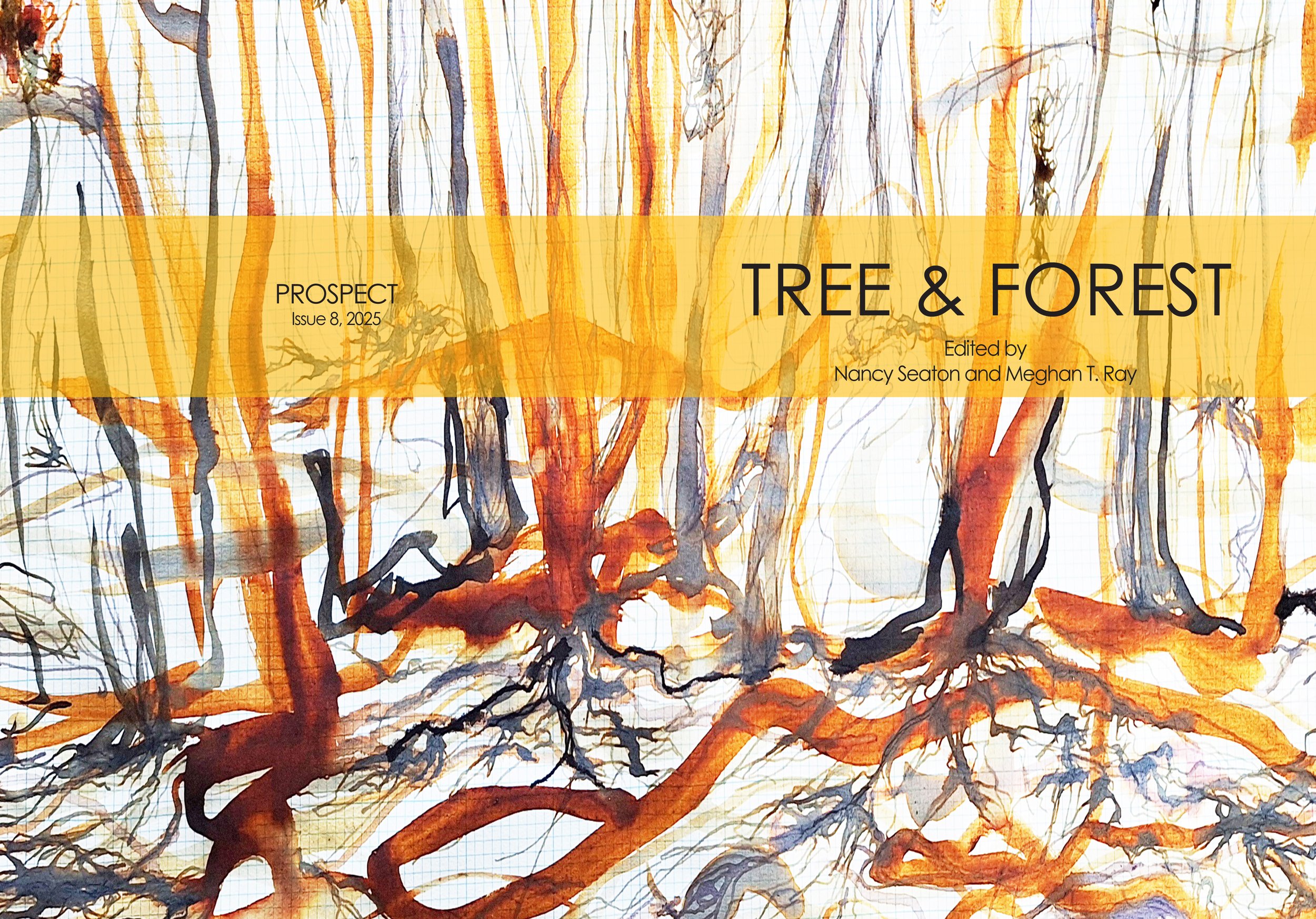
We invited participants to contribute to the eighth issue of Prospect, entitled “Tree and Forest,” inspired by the diversity of silvan perspectives. The invitation was broad: “Explore forests as literary tropes. Detail a specific tree genus, specimen or ecosystem. Describe traditional pruning practices or efforts at climate migration. As with all previous issues, we hope the prompt will inspire a range of interpretations through varied form and media—sketches, poetry, prose, collage, photography, etc.”
This issue is one of our best! Contact me for more information or if you are interested in collaborating on a future issue.
Prospect is a forum to encourage interdisciplinary and critical response to myriad themes in landscape studies. Experimental methods, narratives, and works-in-progress are encouraged, as this journal is produced outside the bounds of academia (or academic convention). The goal of this endeavor is not to present an exhaustive study of the theme, but rather, the collection of projects can convey a plurality of thought at a specific moment in time.
Despite this being an age of digital media, our advisory council has decided to exchange these responses in a physical format.