• ABOUT
  • PROJECTS
  • ABROAD & AFIELD
  • BOOKS
  • CONTACT

LAND | kunst

  • ABOUT
  • PROJECTS
  • ABROAD & AFIELD
  • BOOKS
  • CONTACT

PROSPECT VIII: TREE & FOREST, printed fall 2025

“Forests embody another, more ancient law than the law of human civilization”

 —Robert Pogue Harrison, Forests: The Shadow of Civilization

 “[A] forest is not one thing, it’s many things, many different creatures, many different species, and forests take all sorts of different forms.”

—David Haskell

People select tree specimens to populate their gardens as one would choose any other object such as a sofa or wallpaper, guided by specific forms, color, fruit, or even a tree’s nativity. They are denatured pets in the middle of lawns and along streets, certainly valued for their aesthetic appeal and the shade they offer, but their arboreal otherness is typically unexamined. Even basic physical differences between species are largely ignored by most. What does the bark of a particular tree feel like? How do its leaves smell or sound? Where is it from and how healthy is it? Their parts have been parsed, Latin binomials have been bestowed, but the experience and agency of these life forms remain contested in current scientific and philosophical works—a foundational question with origins in the writings of Plato and Aristotle. While anyone educated in the late 20th century learned to disavow projecting purpose and volition, in a human sense, onto other organisms, trees can and do exchange nutrients through symbiotic, mycorrhizal networks based on localized need and can alter growth to adapt to abiotic and biotic factors. Is this agency? Despite their seeming familiarity, trees and their forested realm remain alien to full human knowing.

The otherness of forests is captured in the Latin root of the word, foris, which surprisingly means outdoors, or from abroad, rather than a wooded area. Foris is also a legal term that describes expulsion or banishment from a territory, because forests are not only ecosystems, they can also be jurisdictions with laws of conduct and exclusionary prohibitions. They are rarely without a trace of current or former human manipulation and inhabitation, though perceived as wild. Forests have long been associated with supernatural phenomena and freedom from societal norms, striking both fear and reverence.

We invited participants to contribute to the eighth issue of Prospect, entitled “Tree and Forest,” inspired by the diversity of silvan perspectives. The invitation was broad: “Explore forests as literary tropes. Detail a specific tree genus, specimen or ecosystem. Describe traditional pruning practices or efforts at climate migration. As with all previous issues, we hope the prompt will inspire a range of interpretations through varied form and media—sketches, poetry, prose, collage, photography, etc.” 

This issue is one of our best! Contact me for more information or if you are interested in collaborating on a future issue.

Prospect is a forum to encourage interdisciplinary and critical response to myriad themes in landscape studies. Experimental methods, narratives, and works-in-progress are encouraged, as this journal is produced outside the bounds of academia (or academic convention). The goal of this endeavor is not to present an exhaustive study of the theme, but rather, the collection of projects can convey a plurality of thought at a specific moment in time.

Despite this being an age of digital media, our advisory council has decided to exchange these responses in a physical format.

Friday 01.16.26
Posted by Nancy Seaton
 

TREE TO TIMBER

“We are increasingly interested in where materials come from and what their production entails from an ecological and social perspective. But it is often hard to find good information on this subject.”

 —Jane Hutton “Wood Urbanism” 2019

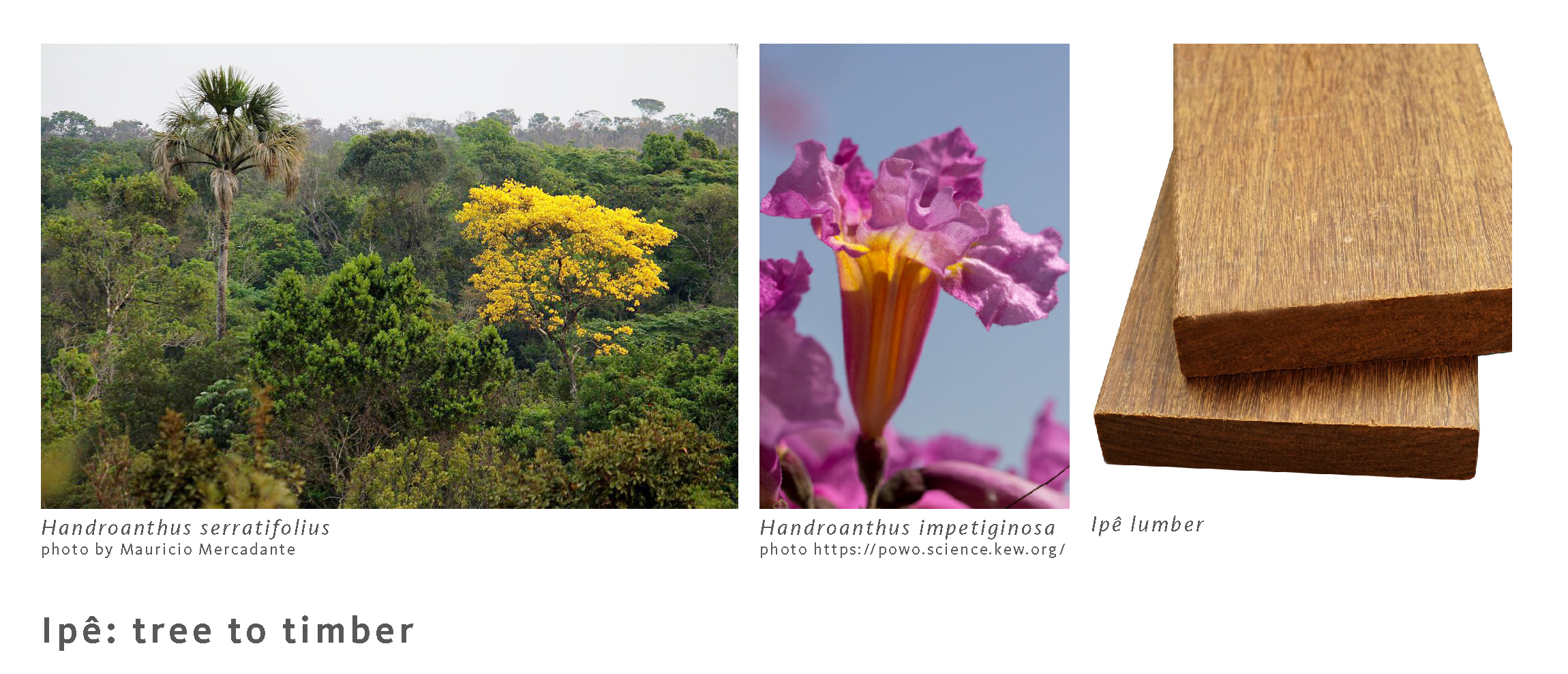
The inclusion of wood in a landscape can provide a sense of warmth that glass, concrete, stone, and metal do not. Ipê, a tropical hardwood, has been a favored choice for designers and clients alike in outdoor applications, due to its durability. However, the cost of this wood extends far beyond dollars per board foot, at the expense of the wild places from where it is extracted—often intact forests in South America. Ipê is not grown as a plantation wood; rather, it is “hunted” in the wild. The tree’s large flowers bloom in the dry season, before their leaves have emerged, making it an easy target for harvesting. The trees are slow-growing and occur in low densities, as infrequently as one mature tree per twenty-five acres, and as many as one for every seven acres. Less valuable trees and other vegetation surrounding ipê specimens are cut as collateral damage on the path of harvest, an ecologically devastating practice.

Biologically, several species are branded as “ipê” in the trade, most in the genus Handroanthus (formerly Tabebuia), including H. serratifolius, H. impetiginosus, H. chrysanthus, H.heptaphyllus, H. guayacan and, H. billbergii. While these are some of the most common Handroanthus used for timber, others, of the 35 species in the genus, are sought-after ornamental trees, incorporated into landscapes for their stunning pink or yellow blooms (dependent upon species). The number of common names is equally impressive: ipê, tajibo, lapacho, guayacan, primavera, amapola, tahuari, apache, maculís, palo de rosa, rosa morada, cortez, cortez negro, guayacán amarillo, cortés amarillo, corteza amarilla, roble, poui, pau d’arco, epay, and Brazilian-walnut. The lengthy list of names speaks to the wide distribution range and diversity of species: from Central America and Mexico through the northern extents of Chile, Argentina, and Paraguay. Recently, the common name “ipê” has been applied to other species in the trade, such as Dipterix odorata (cumaru) and Eucalyptus marginata (jarrah).

The annual Convention on International Trade in Endangered Species of Wild Fauna and Flora (CITES) determines which plants are officially considered endangered and regulated. In 2022, it was proposed that the genus Handroanthus, along with the related species Roseodendron and Tabebuia, be considered for inclusion on Appendix II of CITES. It is now formally recognized that wild populations of these trees have been reduced to such an extent that continued harvesting, without regulation of trade, threatens species survival. A similar proposal in 2019 was withdrawn. Ipê (or species of Handroanthus, Tabebuia, and Roseodendron) ) are not only being extracted unsustainably, but are also difficult to differentiate from one another, especially as de-natured slabs of timber. Wood color presents a spectrum, from rich brown to a distinctly yellowish hue in a natural variety.

The Forest Stewardship Council (FSC) was founded in the early 1990s after the first United Nations Earth Summit in Rio de Janiero, Brazil to prevent unsustainable forestry, monitor trade and to promote “environmentally appropriate, socially beneficial, and economically viable management of the world's forests" (in the words of the FSC online mission statement, 2022). FSC maintains a certification and labeling program that ostensibly demonstrates how timber products have met a set of rigorous management and processing standards, but this system may be less effective in practice than in aspiration. A host of critics have called timber certification greenwashing, and, more severely, likened it money-laundering.[i]  Some have found flaw in the certification process that does not track individual units of wood, but rather certifies companies and forest management units. Specific points of origin for timber are hard to monitor—whether from a certified forest, or not, and the high value of ipê makes it especially vulnerable to illegal trade. FSC-certified products are often priced roughly 25% higher than uncertified wood, which covers the costs associated with maintaining certification standards for forest management, chain of custody, group certification, and fiber sourcing—the four criteria for FSC certification.

Higher commercial costs also assuage the consciences of those in distant markets; in Europe, Canada, and the United States of America, by far the largest consumers of ipê, which combined make up 85% of the demand.[ii] Once imported, the boards are primarily used for basic landscape features such as decking, fence posts and railway tracks; an inglorious end to such sparsely populated trees. In 2008, New York City’s Office of Long-Term Planning and Sustainability, established by Mayor Mike Bloomberg, made the first steps to curb reliance on tropical hardwoods through the publication of The Tropical Hardwood Reduction Plan. This document pledged to reduce the city’s consumption of this lumber by 20%, acknowledging the city’s contribution to global climate change and provided actionable steps to utilize more sustainable find replacement materials. The plan also offered a detailed account of wood use by the Department of Parks and Recreation and other agencies for boardwalks, promenades, marine terminals, and park benches, but it has been difficult to trace the city’s actions to achieve this commitment over the subsequent fourteen years.

Many of the proposed alternatives outlined in the The Tropical Hardwood Reduction Plan are already being tested around New York City; black locust lumber, plastic composites, concrete, and thermally treated pine, oak, and ash have all been implemented in various conditions, and each carries its own positive and negative environmental baggage (to be traced in subsequent FGS articles). Some practitioners propose new modes of engagement and investment in more sustainable forest futures. Winners of the recent competition Reimagining Brooklyn Bridge (2020) sponsored by the Van Alen Institute strategized to work with a team of scientists, conservation organizations, and community foresters employing low-impact harvesting methods in Guatemala’s Maya Biosphere Reserve. Other steps have included stricter legislation on forest commodities, such as the proposed New York Deforestation-Free Procurement Act (2021), which is currently in committee within the Senate. This bill calls for extending an existing ban on ebony and mahogany to other tropical hardwoods for government projects and for state contractors to further certify that timber products used for work are not contributing to deforestation and degradation of ecosystems; similar legislation has recently been reintroduced in California.

Ipê is not just a denatured timber commodity; the many species that go by this name are intrinsic members of diverse South American biomes and forest communities that work together to temper the global environment. Designer and homeowner demands for durable wood in outdoor applications has greatly contributed to the rampant harvesting and over-consumption of ipê and other tropical hardwoods; it is this demand that must be discouraged if we are to make a significant impact on the deforestation and destruction of critical ecosystems that is accelerating climate change.


[i] https://e360.yale.edu/features/greenwashed-timber-how-sustainable-forest-certification-has-failed, 2018.

[ii] https://www.forest-trends.org/wp-content/uploads/2022/03/Demand-for-Luxury-Decks-in-Europe-and-NA-is-Pushing-Ipe-to-the-Brink-of-Extinction.pdf.
Friday 01.16.26
Posted by Nancy Seaton
 

PROSPECT VII: BOUNDARIES

For many of us, personal boundaries have become a daily obsession. Hyperaware of proximity and the distance at which human breath comingles, “You are standing too close to me” might be thought or spoken even as we dwell on the sustained physical absence of friends and co-workers over the past 12 months.


Boundaries can be physical divisions: walls, membranes, rivers, masks. They may also be manifest as cultural expectation, as abstract lines on a map or as classifications between matter. Conceptualized as such, these artificial delineations control people and places through a variety of means, often violent and often nonconsensual. And yet, boundaries exist in opposition to entropy. They are not durable and they are rendered mutable over time: erected, transgressed and eroded by people, context, revolution and pandemic.


Prospect, Issue #7 is a call to examine boundaries. To share experiences, collective relationships, political awakenings and potent reappraisals of how we relate to the concepts, people and places outside ourselves. We hope this call elicits inspiration for a boundless topic that has political and personal resonance.

—Hans Baumann joins Nancy Seaton as co-editor while Marie Warsh (co-editor of the last 6 issues) takes a leave of absence.

Monday 03.08.21
Posted by Nancy Seaton
 

WASTELANDS RELEASE PARTY!

INVITATION_finale.jpg
Tuesday 02.18.20
Posted by Nancy Seaton
 

PROSPECT VI: WASTELANDS

Our next issue is at the printers and we are planning a release party for early March! Stay posted for details.

Sunday 02.02.20
Posted by Nancy Seaton
 

SUMMER DAZE

Balsa wood models, circa 1965. Seaton Family estate.

Balsa wood models, circa 1965. Seaton Family estate.

I have had a short essay published in GROUND UP, a journal of the Department of Landscape Architecture & Environmental Planning at University of California at Berkeley.

http://groundupjournal.org/modelspace


MODEL SPACE: Placing Memory

My Mother’s House is a collection of short stories by Colette, in which she describes the nuance of home life. Her observations of the small gestures, petty dramas, and fleeting phenomena of the domestic sphere create a more vivid sense of place than a grander telling. The memories of my own mother’s house are full of similar details, unforgettable smells such as horseradish in the blender, a bouquet of mock orange for the piano teacher, chrysanthemums, fresh hay in the field, and old hay in the barn—along with the stench of broccoli boiling on the stove—for home canning.

These distinct, yet disjoint, memories are very much a part of my present experience in the same house, as I organize its inheritance. Much of my time there is spent curating objects and ephemera deciding what will remain a part of our family narrative and what will not. I inhabit the spaces of my childhood, now with the adult worry that my parents must have felt while I was exploring, creating, and playing, all the while reflecting on the lives and choices of my parents.

***

Philosophers, environmental psychologists, and cultural geographers often cite the everyday experiences of physical spaces as central to the creation of self-identity. Space and time structure narratives and memories, organizing movement and events into spatial frameworks—situating the things that happen in places. A mnemonic device developed in antiquity links ideas to physical space, placing them for instance, within the rooms of a house, in a precise order, for enhanced recall. While memories may have a physical context, they are not generally as fixed as they are in the memory palace. They are mutable over time, affected by new experiences and other memories, in a never-ending cross-referencing of impressions.

Memory is affected by the way we perceive space, through episodic, fleeting images rather than as a coherent narrative. Spatial experience is fragmented and subjective, influenced by personal histories and sensory perception, the quality of light on a given day or the temperature. Temporal phenomena heighten memories of experience. Aristotle treats this connection in his essay On Memory and Reminiscence. He defines memory as a perception and as a concept that has been conditioned by a lapse of time and belongs to the primary faculty of sense-perception.

***

During my efforts of organization, I found a portfolio stuffed with blueprints, drawings, collages, wallpaper swatches, lumber receipts, garden designs, kitchen layouts and other precedent imagery for the design of an ideal home that my parents collected when planning to build their house. I also rediscovered two model houses that my mother made, before deciding on the plan that was constructed—one is a modest one story, and the other is a modern split-level. Both models are a little battered, showing the signs of age that include cracks and discoloration; walls are missing, a chimney has broken off and light enters through the seams. The fractured spaces remind me of Gordon Matta-Clark’s deconstructions and his series called Bronx Floors, 1972-1973, in which the worn surfaces, raw lumber and means of assemblage are revealed through domestic archaeology. The pieces, removed from their context, become potent fragments that invite interpretation and association.

I documented each house with a series of photographs taken at different times of the day—my slim camera enabling views from within the model space. The images tread between reality and abstraction depicting miniaturized spaces that can never be occupied and capture the surreal feeling of being in a space at once familiar and foreign, between states of the remembered, present, and idealized.

***

Balsa wood models, circa 1965. Seaton Family estate.

Balsa wood models, circa 1965. Seaton Family estate.

References

Aristotle. On Memory and Reminiscence. http://classics.mit.edu/Aristotle/memory.html

Colette. My Mother’s House and Sido. New York: The Noonday Press, 1991 (fourteenth printing).

De Certeau, Michel. The Practice of Everyday Life. Berkeley, London, and LA: University of California Press, 1984, translated by Steven Rendall.

Heidegger, Martin. Being and Time. New York, London, Toronto...: HarperPerennial ModernThought, 2008, translated by John Macquarrie and Edward Robinson.

Lee, Pamela. Object to be Destroyed: the work of Gordon Matta-Clark. Cambridge, London: The MIT Press, 2001.

The Stanford Encyclopedia of Philosophy (https://plato.stanford.edu/entries/time-experience/).


Sunday 07.14.19
Posted by Nancy Seaton
 

CALL FOR PROJECTS

NEW CALL FOR PROJECTS: PROSPECT ISSUE #6, WASTELANDS

Wastelands are anthropogenic landscapes in construction and conception; they are the places where we inter our excrement, land we perceive as worthless, and, generally, spaces we avoid. 

 The theme offers a breadth of provocative topics, which we invite you to explore for the sixth issue of Prospect. Devalued hinterlands, post-industrial lots, dumps, abandoned malls, battlefields, swamps, barrens, garbage vortices, and suburbia are just of few of the places that we hope will inspire your diverse responses to our call, defining or subverting the ever-shifting term of Wasteland.

 What do you consider a wasteland, what have they been, and what will they be in the future?


Prospect is a forum to encourage playful and critical response and a collaborative and interdisciplinary approach to central themes in landscape studies.

sandy_2012.JPG
Sunday 02.10.19
Posted by Nancy Seaton
 

NEW YEAR!

Marie Warsh is in the process of finishing her book on playgrounds with the Cultural Landscape Foundation. Other members have moved to new cities, been appointed as research fellows and have started their own enterprises. I purchased a small printing press a couple months ago, and have been rolling out various projects.

We hope 2019 will be a stellar year for all and hope to see you in the field!

IMG_002b.jpg
20190119_151351_HDR.jpg
treedup.jpg
Sunday 01.20.19
Posted by Nancy Seaton
 

Autumn 2018

Marie and I are taking a short hiatus from Prospect but plan to announce our call for projects in January, 2019. In the meantime, members have been active with a vast array of individual projects. More to follow…

Devildeerrunrun
Saturday 11.10.18
Posted by Nancy Seaton
 

SEPTEMBER 2017 - SUMMER'S END

Short animation: photos taken from the edge of a beaver dam. 

Short animation: photos taken from the edge of a beaver dam.


Sunday 09.24.17
Posted by Nancy Seaton
 

AUGUST 2017 - PALMS IN CALIFORNIA

Closeup of fruit on fan palms Washingtonia filifera in Riverside ca 1903-1920

Brief history of palm trees in Southern California, found while searching for desert images. https://www.kcet.org/shows/lost-la/a-brief-history-of-palm-trees-in-southern-california 

Brief history of palm trees in Southern California, found while searching for desert images. 

https://www.kcet.org/shows/lost-la/a-brief-history-of-palm-trees-in-southern-california


Saturday 08.19.17
Posted by Nancy Seaton
 

JUNE 2017 - OASIS IMAGES

We are gathering materials for our new issue of PROSPECT, including images and readings to share.above image from: http://sturgisareachamber.com/wp-content/uploads/2012/03/oasis-blog.jpg

We are gathering materials for our new issue of PROSPECT, including images and readings to share.

above image from: http://sturgisareachamber.com/wp-content/uploads/2012/03/oasis-blog.jpg

Saturday 06.24.17
Posted by Nancy Seaton
 

MAY 2017 - SPAIN

I heard music from the Easter processions in the town below as I was perched above in the Nasrid Palaces on an evening visit. 

I heard music from the Easter processions in the town below as I was perched above in the Nasrid Palaces on an evening visit. 

Wednesday 06.14.17
Posted by Nancy Seaton
 

MAY 2017 - SPAIN

Real Jardín Botánico de Madrid

Real Jardín Botánico de Madrid

Wednesday 06.14.17
Posted by Nancy Seaton
 

Powered by Squarespace.